

Worth Reading: From Charitable Transactions to Charitable Strategy
September 10, 2026Our team keeps an eye out for credible reading material to help you stay up-to-date on trends and techniques for advising charitable clients.
Two recent articles make a common point: the most effective charitable planning rarely happens in response to a single tax event. Instead, it grows out of ongoing conversations about a client’s values, family, financial goals, and legacy.
Read Now: “How to Turn Wealthy Clients’ Charitable Giving Into a Cohesive Plan” (Kiplinger)

This article encourages advisors to move beyond treating charitable gifts as one-off transactions and instead help clients develop a coordinated philanthropic strategy across tax planning, estate planning, wealth transfer, and family dynamics.
Biggest Takeaway: 88% of high-net-worth clients consider it important to discuss philanthropy with their advisers, and 80% believe advisors have a professional or ethical responsibility to raise the subject. For advisors, the question isn’t whether your clients are giving, it’s whether their giving is as intentional as intended — and whether they have the right partners involved.
Read this if… you have clients interested in moving from reactive giving to strategic philanthropy.
Read Now: “When Clients Ask About Their Tax Bill, the Answer Might Be Philanthropy” (Advisor Perspectives)
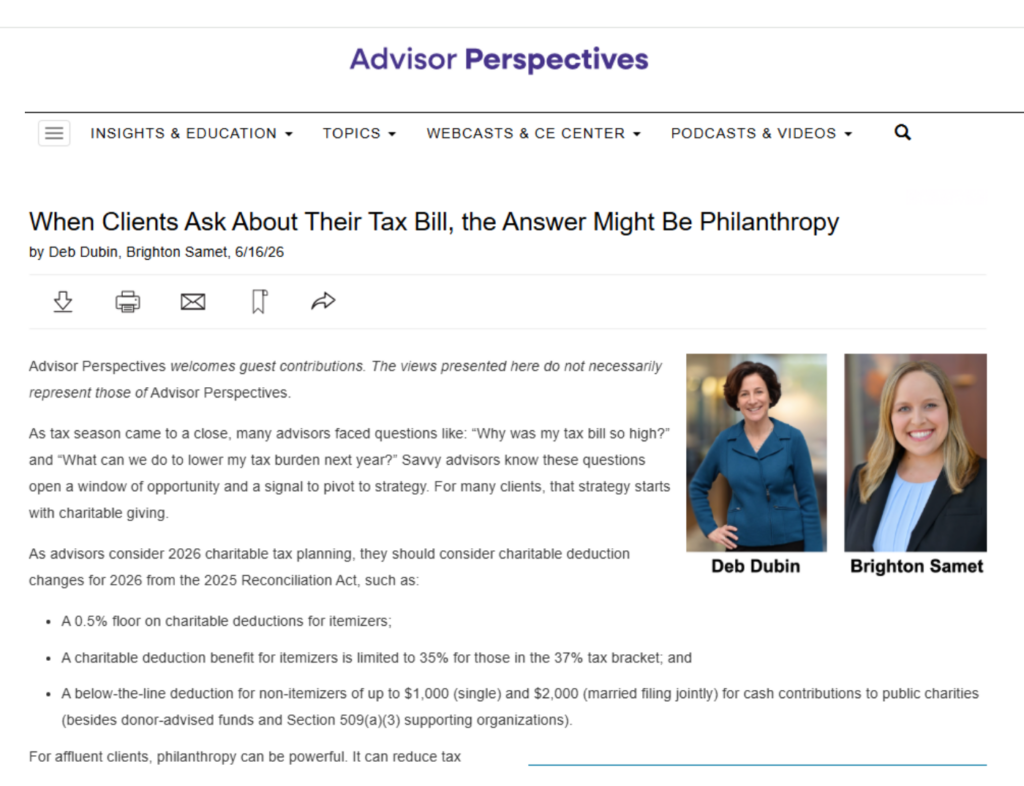
The focus of this article is that major tax events — such as business sales, retirement plan distributions, or highly appreciated assets — often create ideal opportunities to discuss charitable giving. Even though the transactional elements might spark a conversation, substantive charitable planning goes far beyond a single transaction and is most effective when it becomes part of a broader financial planning conversation.
Biggest Takeway: Good advisors start the conversation about charitable giving when there’s a major tax event, but great ones don’t end the conversation there. (Dive deeper into high-value questions for charitable clients with our recent advisor spotlight.)
Read this if… you have a client frustrated over their tax bill, and you want to better recognize the specific financial moments when charitable planning techniques can be particularly valuable.
The Common Thread
Charitable planning is most effective when it starts before the check is written — and before a tax or financial event makes the decision urgent. By asking clients about their values and focus areas early, advisors can help make philanthropy a more intentional part of the overall wealth plan. The Community Foundation is here as a sounding board when those conversations arise. Email Kayleigh Rae Stampfler, director of legacy giving, to continue the conversation: kstampfler@racf.org.
Looking Ahead: Pending Legislature to Watch

Many attorneys, CPAs, and financial advisors are recommending that clients age 70 ½ and older take advantage of Qualified Charitable Distributions (QCDs) from traditional IRAs. Your client can direct a QCD to a designated fund, field-of-interest fund, scholarship fund, or unrestricted fund.
Because QCDs are so useful, we’ve got our eyes on pending legislation that might expand the ways your clients can use them.
Congress continues to consider two bipartisan bills that could expand charitable giving options. The Charity Parity Act (S. 2204/H.R. 4495) would permit QCDs directly from employer-sponsored retirement plans, such as 401(k)s, in addition to traditional IRAs. The IRA Charitable Rollover Facilitation and Enhancement Act (S. 3975) would extend QCD eligibility to donor-advised funds. Neither proposal has advanced beyond committee, but both are still active. We will keep monitoring these bills and keep you posted about changes that could benefit your clients.
« Back to News